
The Verderers Court
Oak wood panelling and dark beams enclose the large, open space. Long wooden pews and benches give the air of a rural church, a mixture of heaviness and lightness delineated in timber. The air carries a weight of English oak and the shuffle-mutter of people making their way in and sitting down. Mounted stag heads peer out from the walls and over the crowd gathered to hear today’s proceedings. For this is no church, but a court - one with the same power as a Magistrate’s court. It is the Verderers* Court of the New Forest.
The room quiets as ten men and women rustle onto the raised dais at the front of the hall, all in green blazers, the verderers themselves. A man takes to something that looks like a dock, and cries ‘Oyez, Oyez!. All manner of persons who have any presentment to make or matter or thing to do at this Court of Verderers, let them come forward and they shall be heard. God save the King’. Secretly I hope a fool’s stick will be waved, or some morris gesture appear - but alas, it is not to be.
There’s tweed abounding, and combined with the coat of arms hanging austerely over the verderers heads, and the feeling of history in this 17th century building, I am transported to a different world. A world of formalised greetings and traditional language of verderer, agister* and presentments*. It’s a view of England captured by Kipling, a rural idyll lamented for its loss across the country.
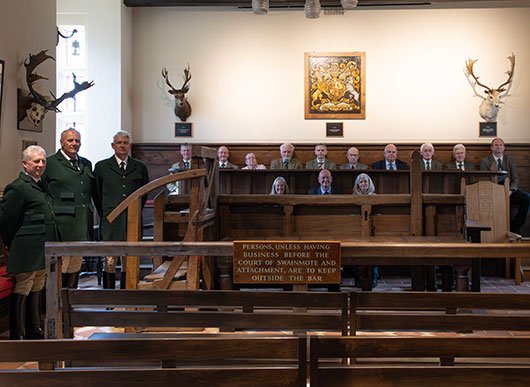
Photo Credit: https://www.verderers.org.uk/verderers-court/
History of the Court
The court was established in the 13th century, authorised by the crown to deal with minor offences in the king’s private hunting reserve. During the 17th and 18th centuries, their powers were expanded to deal with trespassers and breaking inclosure fences, which were put in place to protect growing timber trees.
This, however, was not without controversy, and the successive legislation around fencing in trees and managing deer resulted in vigorous opposition that led to the New Forest Act 1887. The current format of the court can be traced back to this date, making the Verderers Court a statutory body, governing the commoners, common rights and the New Forest landscape itself. In 1949 the verderers were given the power to make byelaws, and the range of issues has expanded since then.
The Verderers Court Now
The Verderers Court consists of ten people - five are elected by the commoners, four are appointed by DEFRA, the Forestry Commission, New Forest National Park Authority and Natural England. The final appointee is the Official Verderer, who is appointed by the crown. None of the elected verderers or the official Verderer are paid, which in itself means that a certain level of privilege is needed to be able to fulfill the duties.
This is reflected in the diversity of the verderers. All of a certain age (mid 50s and above), white, and all but one are propertied. We were assured that the three women sitting as verderers represented a great leap forward, happened only recently.
Court Proceedings
The Official Verderer, after ye olde introduction, stands to make the announcements. Two large issues loom. The first is around a plan to split the New Forest under two different councils in the new two-to-one tier system. Feelings are high and strongly opposed to this, foreseeing the inevitable problems that would arise when you have a community and ecosystem as coherent as the New Forest split between local authorities.
The second major issue, which is also raised in the presentments* (more on that later), is around agri-environment schemes. Currently the scheme they’re in will end in 2028, and they are not able to apply for a successor, because the Rural Payment Agency’s computer says no - even in this court that lingers in tradition can’t escape the vagaries of modern technology. Landscape Recovery Scheme will not work with commoners, so they are left without any options.
This is a dangerous place to be. The state of nature on commons is as hotly contested in the New Forest as anywhere else in these lands, but there is no denying that the New Forest has incredible natural history, and has done considerably better than many places in conserving biodiversity. Without government funding though, what will they do? Angry people make angry choices, and as has been threatened elsewhere, they could conceivably decide to stock to the limit to maximise economic benefit. How are we supposed to ensure recovery for nature when the government won’t enable agri-environment schemes for the commons, home to 21% of our SSSIs (Sites of Special Scientific Interest) and a major part of our national parks and landscapes?
It is followed by more local affairs - fencing for stock, vehicle collisions with animals, a reminder that grass cuttings are dangerous for ponies. Then people were allowed to make their presentments - essentially a speech to the court and the verderers. Open to anyone and everyone, not just commoners, a public forum to air concerns. These touched on topics such as car parks, campsites, the possibility of the outbreak of disease, and a rather bristly reminder to Forestry England that the land they claim is theirs is, in fact, merely rented by them.
Then suddenly, abruptly, an announcement that it is over. The court closes, and I, and the people I had visited with, wonder at the silence of the verderers.
My Impressions
As with all things commons, there was some good, some bad, and some ugly. My first thought was - why don’t we have this everywhere? How many places are there in the country that you can go monthly, to an open public forum, and have your voice heard? We have MP surgeries sure - but they’re often away, often uninterested in their local constituents, and in a closed environment. They are not on public record. The Verderers Court is.
Then, during discussion, it became obvious that there were underlying issues. The verderers themselves are representative of a certain type of person and outlook, and many of the people making presentments were the same. As was pointed out to me afterwards, the issue of campsites, undesired by everyone in the room, means that many people on low income would have no access to the New Forest. Who can afford £100+ a night to visit? A campsite means you can stay for as little as £8. Arguments were made that they are in ancient ornamental woodland - and this is definitely something to be considered, and plans made to move the campsites can be made - but they shouldn’t just be closed. And as the blunt but very incisive Paul Powlesland pointed out - what about the roads and the houses? Surely they damage the New Forest too?
The tradition of the court was fascinating, but it was accompanied by a feeling of being static and unchanging, rather than something vital. A lack of youth was keenly felt in the room, probably not helped by the fact that this was on a Wednesday morning. The fact that none of the presentments were discussed, but instead would be taken away and discussed behind closed doors, to be pronounced on later , felt at odds with the public nature of the court itself. A lack of transparency around decision-making felt uncomfortable.
The way animals and the forest itself was discussed was very much as property. Not surprising given our culture, but looking at it from a Rights of Nature perspective, it didn’t sit well, particularly referencing animals that had been ‘humanely destroyed’. Instead of killed? Euthanised?
Despite all these misgivings though, I feel that even as it stands, the example of participatory democracy stands as a lesson for the rest of the country. In a culture where we are so starved of a voice other than a vote or mounting campaigns, a local forum to gather with decision makers and have your voice heard, open to anyone and everyone is almost revolutionary. If every town had something similar, I think we would be in a rather different position than we are in today.
One thing that stood out was a feeling of the interconnectedness of the commoners and the New Forest. To them, it seemed, there is no difference. Now this comes with its own set of problems - how can we tell the difference between making decisions that benefit us as humans and saying that's what the forest needs, and truly making decisions that benefit the forest? How much of of our extractive culture has crept into our culture and thinking about the land? However, in this age where we desperately need to recreate our connection to land and nature, the New Forest commoners are strides ahead of most of us.
Overall, the court is a microcosm of the commons today - not without issues, enclosed by our western culture of dualistic rationalism and private property capitalism, and needing to move with the times - but with a solid idea at its heart that can show us a way to a better future.
*Table of Terms
Verderer - Member of the court governing commons in the New Forest.
Agister - Assists in the management of commoners’ stock on the Forest, and carry out instructions given to them by the Court of Verderers.
Presentment - Public petiton presented to the court.
References